
For tree removal in Grants Pass, call (541) 507-9679. The call is free, and it puts you through to a single tree service in the Grants Pass area, independent of this site and holding an active Oregon CCB license. From there the company takes over. It arranges a look at the tree and prices what it would take to bring it down. A routine job is seldom billed for its estimate, but the company sets that rule, so raise it while you have it on the phone and ask for the price on paper. You decide whether to hire it.
How a free referral call works
Tree Removal Grants Pass is a phone number and a website that connect Grants Pass homeowners with a tree company. It does no tree work. Nobody from this site will come to your yard, climb your tree or quote you a price.
Here is what happens when you call (541) 507-9679 or send the form above:
- You describe the tree. Say where it stands, what is wrong with it and how soon it needs to go. A photo helps if you use the form.
- You are put through to just the one tree company, an independent business that works around Grants Pass and holds an active Oregon CCB license. Your request goes to that company and no other.
- The company works out with you when it can look at the tree and what the job would cost. Check whether the estimate carries a fee, which is rare on a routine job, and have the price put on paper. You can say yes, say no or get other estimates.
The whole process stays between you and the company once you are connected. Price, schedule, cleanup and payment are agreed with the company directly. The how it works page explains each step in more detail, including the one check this site makes on the company's license and how to repeat that check yourself.
Who pays for the referral
You pay nothing to this site. The tree service on the other end of the line pays Tree Removal Grants Pass for referrals, such as a fee for each qualified call or request. That fee does not appear as a line on your estimate, and nothing about the call commits you to hiring the company. The referral disclosure spells out how the arrangement works and what the site does not do.
Because a company pays for the call, you should still check it the same way you would check any contractor. The section on checking a company, further down this page, lists what to ask.
Signs a tree in Grants Pass should come down
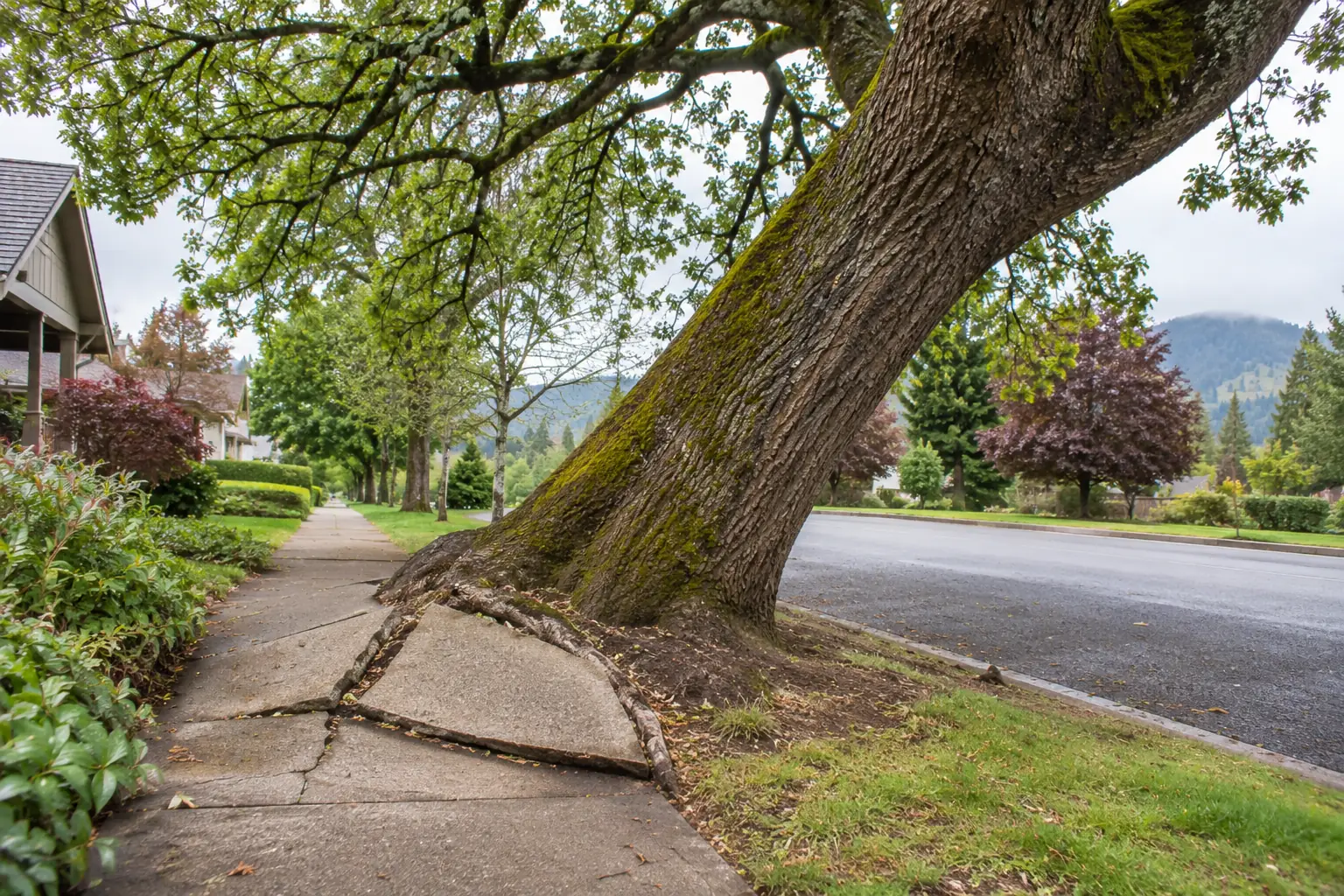
A tree is a removal candidate when part of it is likely to fail and something or someone sits within reach of where it would land. Oregon State University Extension describes a hazard tree as one with defects that could cause it to fall or drop parts, and its guide to recognizing hazard trees lists decay, wounds, cankers, seams, a lean, loose overhead limbs and mushrooms or conks growing from the trunk as warning signs. The same guide points out that dead trees have a high chance of failure.
Around Grants Pass, these are the situations that usually lead a homeowner to call:
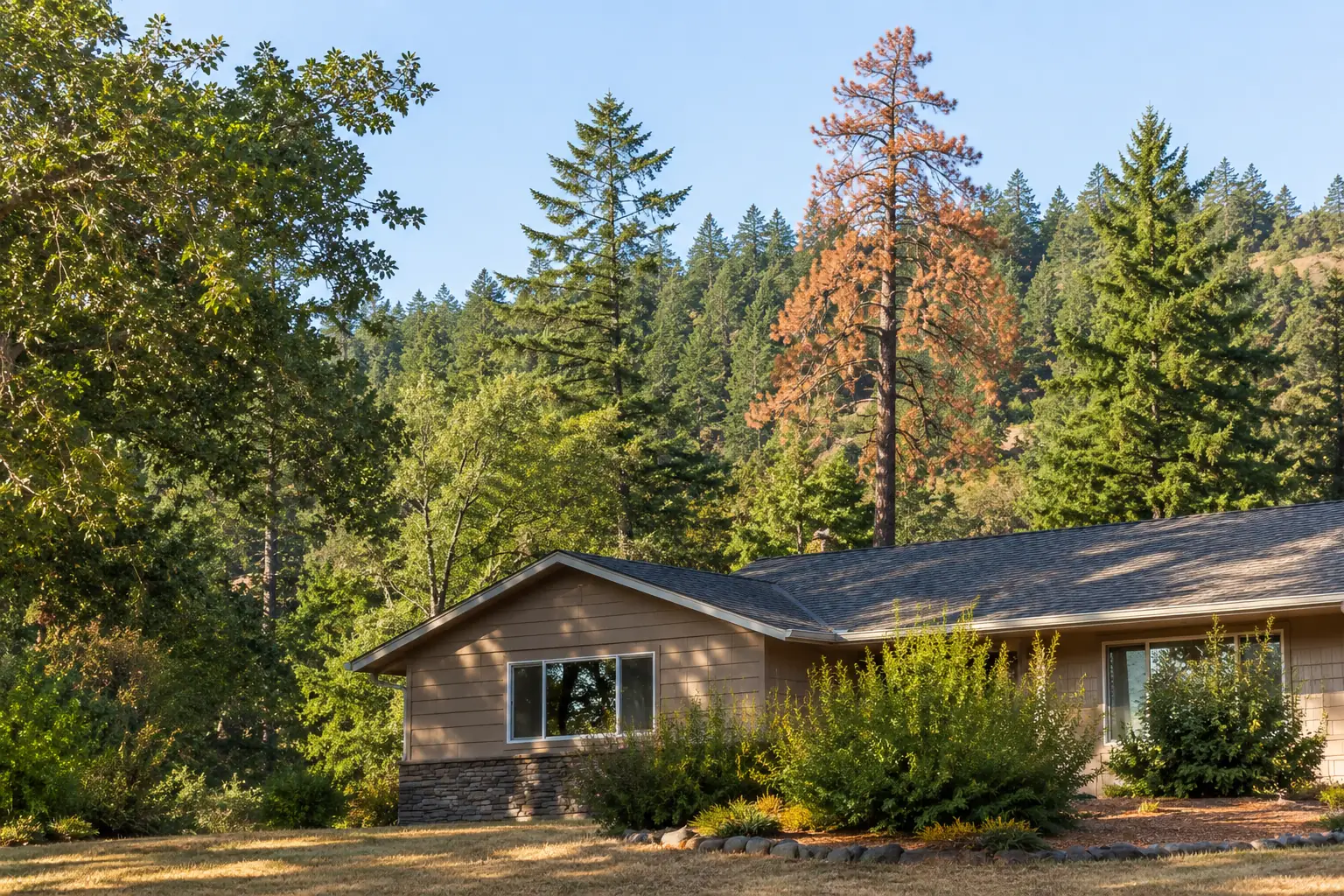
- The tree is dead or mostly brown. Conifers that turn red or brown over one summer often do not recover. Dry wood also becomes brittle and drops limbs.
- A new or growing lean. A tree that has leaned the same way for decades is different from one that started leaning after a wet winter. Look for cracked soil or roots lifting on the side away from the lean.
- Cracks and splits. A seam running down the trunk, or a split where two large stems meet, can open under wind or snow load.
- Rot at the base. Mushrooms, soft wood or hollow sounds near the ground point to decay you cannot see.
- Dead limbs above the roof, the drive or a swing set. A single hanging limb is often a pruning job, but many dead limbs in the crown can mean the whole tree is in decline.
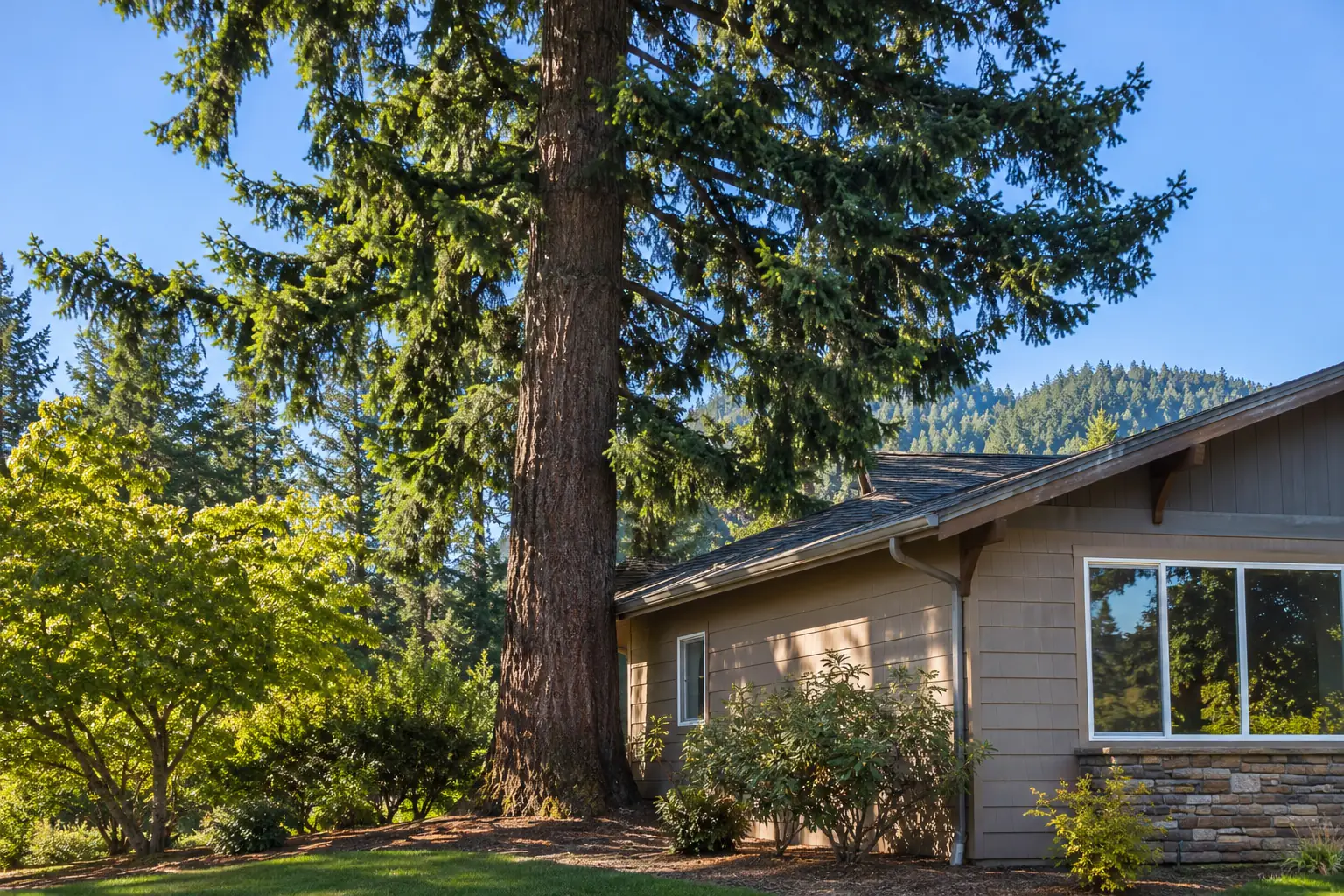
- Too close to the house in fire season. A tree that hangs over the roof or crowds the walls can carry fire to the home. The wildfire section below covers what the state recommends.
Only someone who inspects the tree in person can say whether it needs to come down or can be pruned. Ask the company you reach with one call which it recommends and why. For a longer list of warning signs, see the hazard tree removal page.
What tree removal costs in Grants Pass
Most single-tree removals cost a few hundred dollars to a little over a thousand, and the height of the tree drives the price more than anything else. No public source publishes prices for Grants Pass alone, so the figures below are national ranges from 2026 cost guides. Use them as a rough guide only. The written estimate from the company that sees your tree is the number that counts.
| Job | Typical range | Source and date |
|---|---|---|
| Tree up to 30 feet | $150 to $450 | This Old House, updated March 5, 2026 |
| Tree 30 to 60 feet | $450 to $1,200 | This Old House, March 5, 2026 |
| Tree 60 to 80 feet | $800 to $1,500 | This Old House, March 5, 2026 |
| Tree over 80 feet | $1,000 to $2,000 | This Old House, March 5, 2026 |
| Typical single removal | $385 to $1,070 (average $630) | LawnStarter, updated October 5, 2026 |
| Stump grinding | $158 to $450 | LawnStarter, October 5, 2026 |
| Emergency removal | Up to $5,000 | This Old House, March 5, 2026 |
Several things push a Grants Pass job toward the top of a range or past it:
- Tall conifers. Douglas-fir and ponderosa pine on older lots often reach heights that need climbing, rigging or a crane.
- Tight spaces. A tree between a house and a fence has to come down in small pieces.
- Power lines. Work near a line takes extra time and sometimes a utility disconnect first.
- Slopes and access. Hillside lots and long gravel driveways in the rural parts of Josephine County add hauling time.
- Stump and cleanup. Removal prices often do not include grinding the stump or hauling the wood away. Ask.
- Right-of-way rules. A street tree inside city limits needs a city permit and a prequalified arborist, which can affect who can do the job.
The Grants Pass tree removal cost guide goes through each factor and lists the questions to ask about an estimate.
City of Grants Pass tree rules
Inside Grants Pass city limits, the main rule homeowners run into covers trees in the public right-of-way. The city requires a permit to plant, prune, remove or otherwise disturb a tree on public or semi-public property, including the right-of-way, according to its Tree Permits page. The permit has no fee. The city's Urban Forestry page describes the right-of-way as the strip between the curb and the sidewalk, and it says the landowner is responsible for maintaining trees in that strip, even though the city regulates the work.
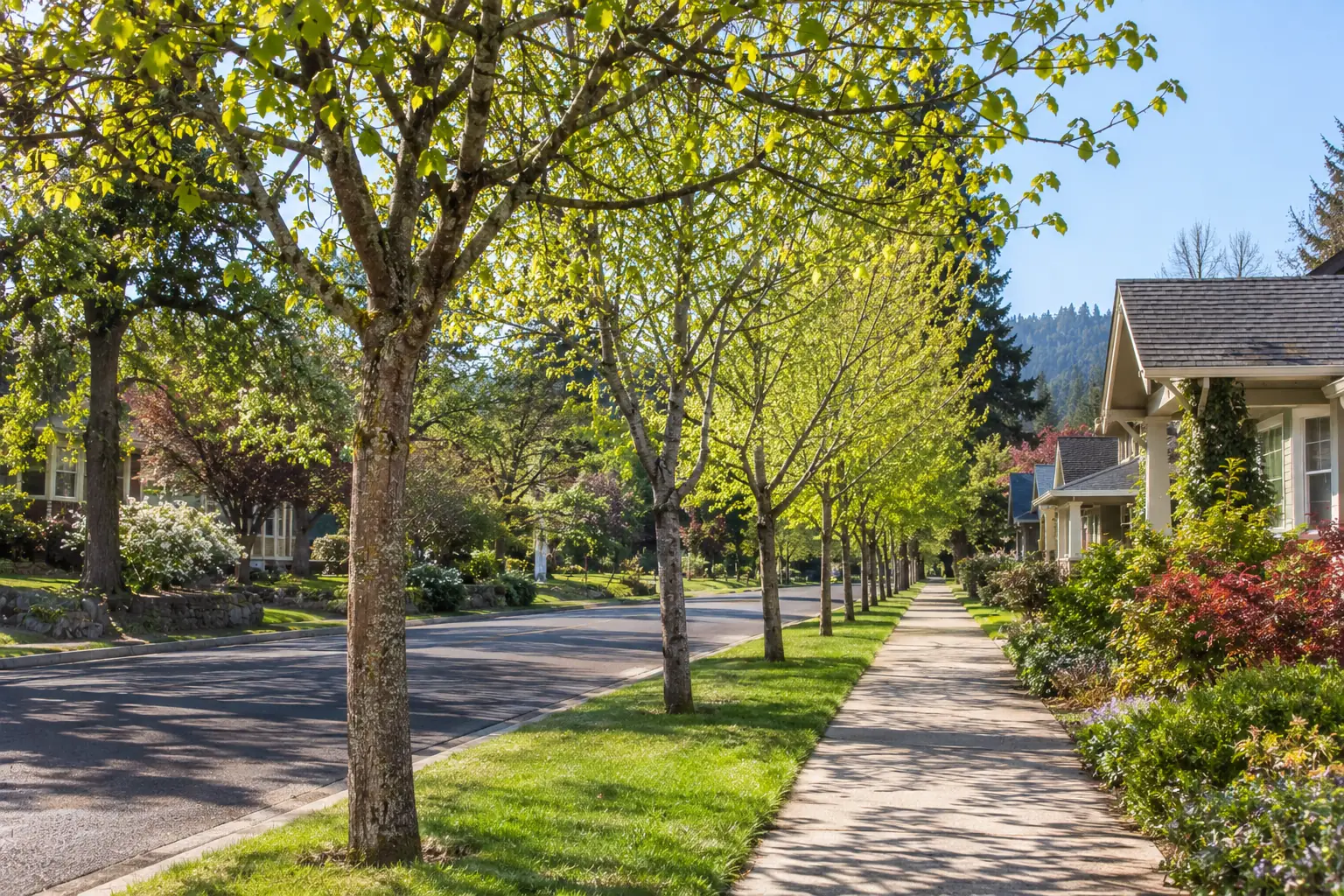
The part that matters most when you hire someone: the city says any contractor working in the public right-of-way must be prequalified by the city. Its Prequalified Arborist Contractors List includes only contractors who are prequalified and hold International Society of Arboriculture (ISA) certification. For a removal or a larger pruning job, the prequalified arborist fills out the permit application with the landowner's consent. The company you reach through this site may or may not be on that list, so if your tree is a street tree, ask the company directly and check the city's current list before any work is scheduled.
Trees on private property, away from the street, are a different matter. The city's tree permit page addresses public, semi-public and right-of-way trees, and the city's own tree FAQ says a permit is needed to prune or remove a tree in the public right-of-way. Development projects follow additional rules in the city's Development Code Article 23, and lots near the Rogue River or a creek can fall under stream rules, covered below. If you are unsure which category your tree is in, call the city's Urban Forester at 541-450-6164 before the work starts.
The Grants Pass tree rules guide walks through street trees, the permit and the replacement planting the city may require.
The Hazardous Tree Program
The City of Grants Pass helps pay to remove some dangerous street trees. Under its Hazardous Tree Program, a tree in the city right-of-way that city staff determine is hazardous may qualify for reimbursement of up to 50 percent of the cost of removing the tree and stump and planting a replacement. The city's Tree Programs page says the city inspects the tree at no cost and that funds are limited.
The steps, as the city lists them:
- Submit a Tree Permit application before taking any action.
- If the tree is found hazardous, get at least three written bids from approved arborists and send them to the City Streets Division for approval.
- After approval, have the work done by the date the city sets, with the permit in place.
- Plant the approved replacement tree and send your receipts to the city.
Read the arborist requirement closely. The bids have to come from arborists the city has approved, and right-of-way work has to be done by a city-prequalified, ISA-certified arborist. A referral from this site does not by itself make a company eligible for the program. If you want the reimbursement, confirm the company is on the city's prequalified list before you collect bids. The city also warns that if a hazardous right-of-way tree is not dealt with after a Notice of Violation, it can remove the tree and place a lien on the property for the cost plus a 20 percent administrative fee.
The Hazardous Tree Program guide covers who qualifies and how to prepare.
Josephine County land outside city limits
Outside Grants Pass city limits, the city's tree permit and prequalified arborist rules do not apply, because they cover city right-of-way and public property. Rural lots in Merlin, Murphy, Williams and the rest of the county follow county and state rules instead.
A few points to know before a rural removal:
- County road right-of-way. Josephine County Public Works issues several kinds of permits for work in the county road right-of-way, and its permit information page lists a Special Permit for temporary use of the right-of-way that includes removal or alteration of vegetation. If a tree stands along a county road, call Public Works at (541) 474-5221 to ask whether a permit applies.
- Streamside trees. The county's Goals and Policies call for streamside vegetation along the larger streams to be substantially protected. If the tree sits on a creek or river bank, check with the county planning office first.
- Selling the logs. Oregon's forest practice rules require the operator, landowner or timber owner to notify the State Forester at least 15 days before a commercial forest operation, according to the ODF forest practices rule book. Cutting firewood for personal use is excluded. If you plan to sell timber from a larger removal, ask ODF whether a notification is needed.
- Fire season. Much of rural Josephine County is protected by the Oregon Department of Forestry, and its fire season rules limit when chainsaws can run. See the wildfire section below.
Rules on rural land vary by zone and by parcel, so treat this list as a starting point and confirm with the county or ODF for your property.
Rogue River and riverfront lots in Grants Pass
Trees along the Rogue River and its side creeks come with stricter rules than trees in the middle of a yard. The city's Development Code Article 24, in the version posted on the city website, sets a 20-foot stream corridor setback from the edge of a stream bank and says that setback is used to preserve riparian vegetation within stream banks and the floodway of the Rogue River. The same section allows trimming to keep vegetation within the banks or to relieve a hazard, and it lets noxious plants be removed if they are replaced within 90 days with plants or rock that hold the bank.
What this means in practice for a riverfront owner:
- Removing a healthy tree from the bank may not be allowed, even on your own land.
- A hazard tree near the water may be handled by trimming or partial removal, but get the city's view first.
- Stream bank work beyond trimming can need a permit from the Oregon Department of State Lands, which the same code section notes.
- Large trees near the river often lean toward the water and can be hard to reach with equipment, which adds time and cost.
The posted version of Article 24 carries an older revision date, so call the City of Grants Pass Community Development department to confirm the current rule before work starts on a riverfront lot. Lots outside the city along the Rogue, the Applegate or the Illinois River fall under county rules, described in the section above.
Trees common around Grants Pass and their problems
The trees Grants Pass homeowners most often deal with are the native conifers and oaks that fill the valley and its hillsides. The city's Development Code Article 23 lists the trees to retain first when land is developed: ponderosa pine, incense cedar, sugar pine, Douglas-fir, black oak, white oak and Pacific madrone, with bigleaf maple, Oregon ash and cottonwood along streams. Each has its own common problems.
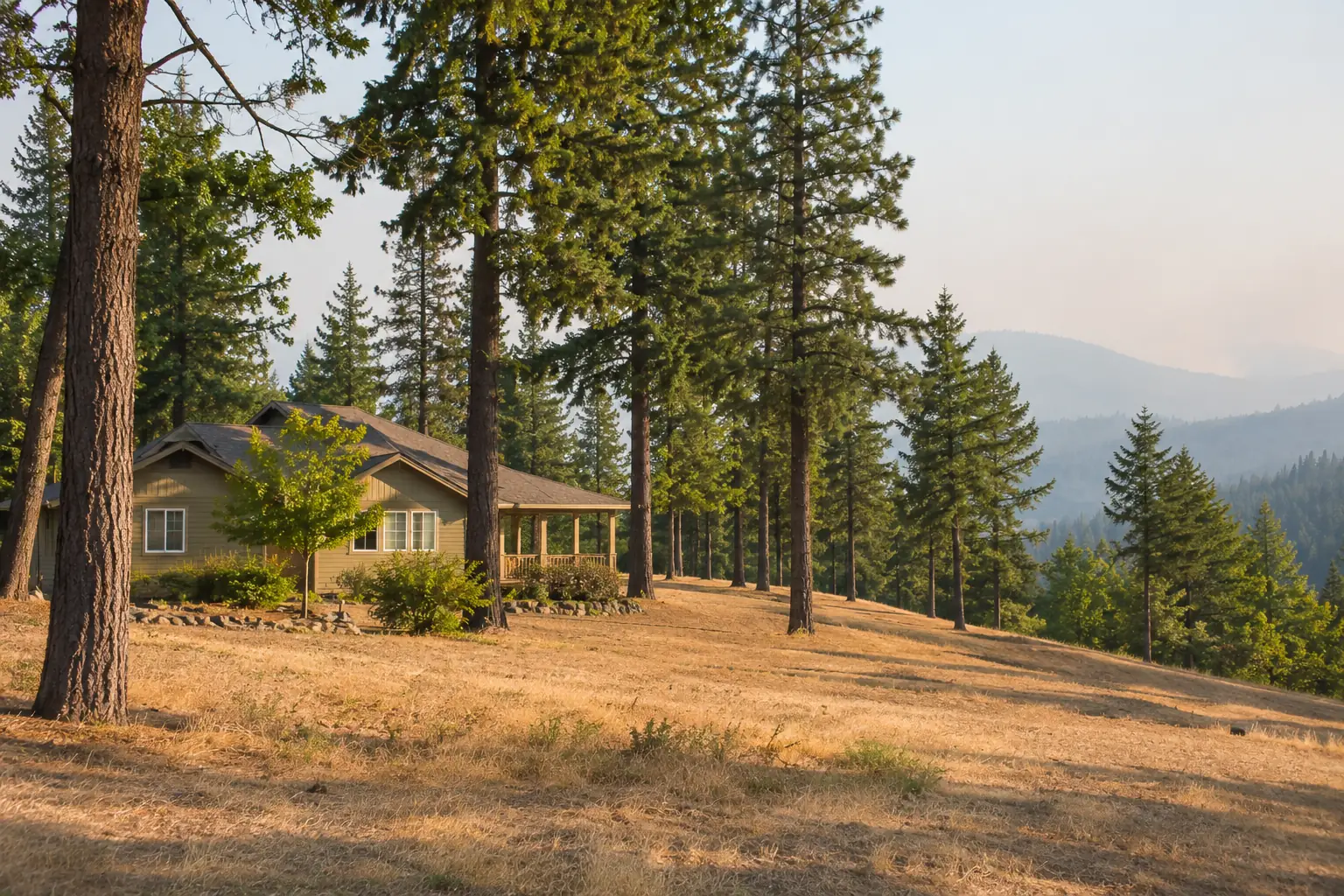
Douglas-fir. Douglas-fir is dying at higher rates across southwest Oregon. OSU Extension's publication Trees on the edge calls Douglas-fir mortality in Jackson, Josephine and Douglas counties a serious and growing issue and ties it to harsh, dry sites, hotter droughts and insects, mainly the flatheaded fir borer. The publication reports that mortality has stayed high since 2015 instead of falling back after each drought. A fir on a hot, south-facing slope that browns from the top down is a common sight, and once that happens it is often too late to save it.
Ponderosa pine. Pines handle drought better than firs, but stressed pines draw bark beetles. The Oregon Department of Forestry's western pine beetle fact sheet notes that thinning crowded pine stands lowers the risk of attack, and its Ips beetle fact sheet explains that these beetles breed in fresh pine slash and then move to standing green trees. That second point matters on removal day: fresh pine logs and branches left in a pile can feed beetles that attack the pines you kept. Ask the company how it will handle pine debris.
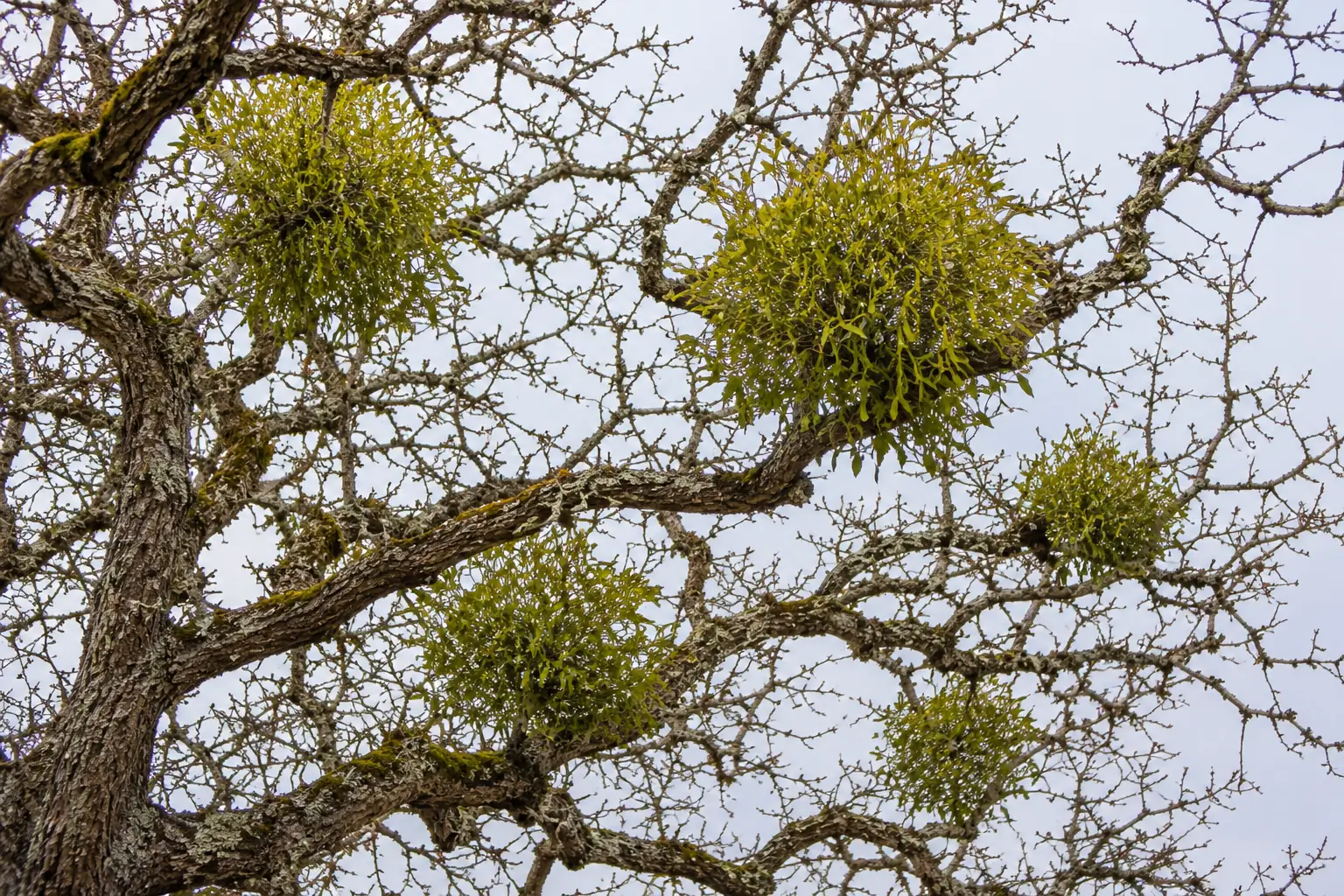
Oregon white oak and black oak. Oaks are tough in dry summers, though mistletoe is a frequent problem. OSU Extension's publication Mistletoe's effects on trees vary by type names Oregon white oak as a regional host. A few clumps rarely harm a tree, but a heavy load can weaken limbs over years. Old oaks also develop decay in large limbs, which is often a pruning question before it is a removal question.
Drought stress in general. OSU Extension's guide Why are my trees dying? explains that drought leaves trees without the resources to resist disease and insects, and it notes that native pines, oaks and madrones resist drought and heat better than many other species. After a run of hot summers, a struggling tree often shows thinning foliage, dead tops and early leaf drop before it dies.
The oak and pine problems guide covers these trees in more depth.
Wildfire season and ODF Southwest Oregon rules
During fire season, tree work on land protected by the Oregon Department of Forestry has to follow the district's fire restrictions, and chainsaws are among the tools limited. In 2026, the ODF Southwest Oregon District declared fire season starting May 15 for about 1.8 million acres of forestland in Jackson and Josephine counties, according to the fire season notice posted by Josephine County Fire District 3.
The district's 2026 regulated closure proclamation, effective May 15, 2026, sets these power saw rules in its regulated use areas:
| Fire danger level | Power saw use |
|---|---|
| Low (green) | No limit |
| Moderate (blue) | Outside 1 p.m. to 8 p.m. |
| High (yellow) | Outside 10 a.m. to 8 p.m. |
| Extreme (red) | Not allowed |
The proclamation also requires a shovel and an extinguisher of eight ounces or bigger with each saw, and a fire watch lasting one hour or more after each saw is used. Battery and electric chainsaws are included. Debris burning is banned for the whole season. The fire danger level changes through the summer, so check with ODF's Grants Pass Unit at (541) 474-3152 before scheduling saw work, and ask whether your property is on ODF-protected land.
For removals done to protect a home, the Oregon State Fire Marshal's defensible space page recommends spacing tree crowns at least 10 feet apart, pruning trees up 6 feet from the ground and removing brush under trees that can carry fire up into the crown. The Applegate and Williams valleys south of Grants Pass get special attention: an ODF-listed fuels project describes the Williams Creek area of Josephine County as being in the highest wildfire risk category and reports rising tree deaths there from drought and insects.
Many companies prefer to do fire clearing in fall, winter or spring, when saw rules are looser. The wildfire tree work guide covers defensible space and the fire season rules in more detail.
Winter storms and fallen trees
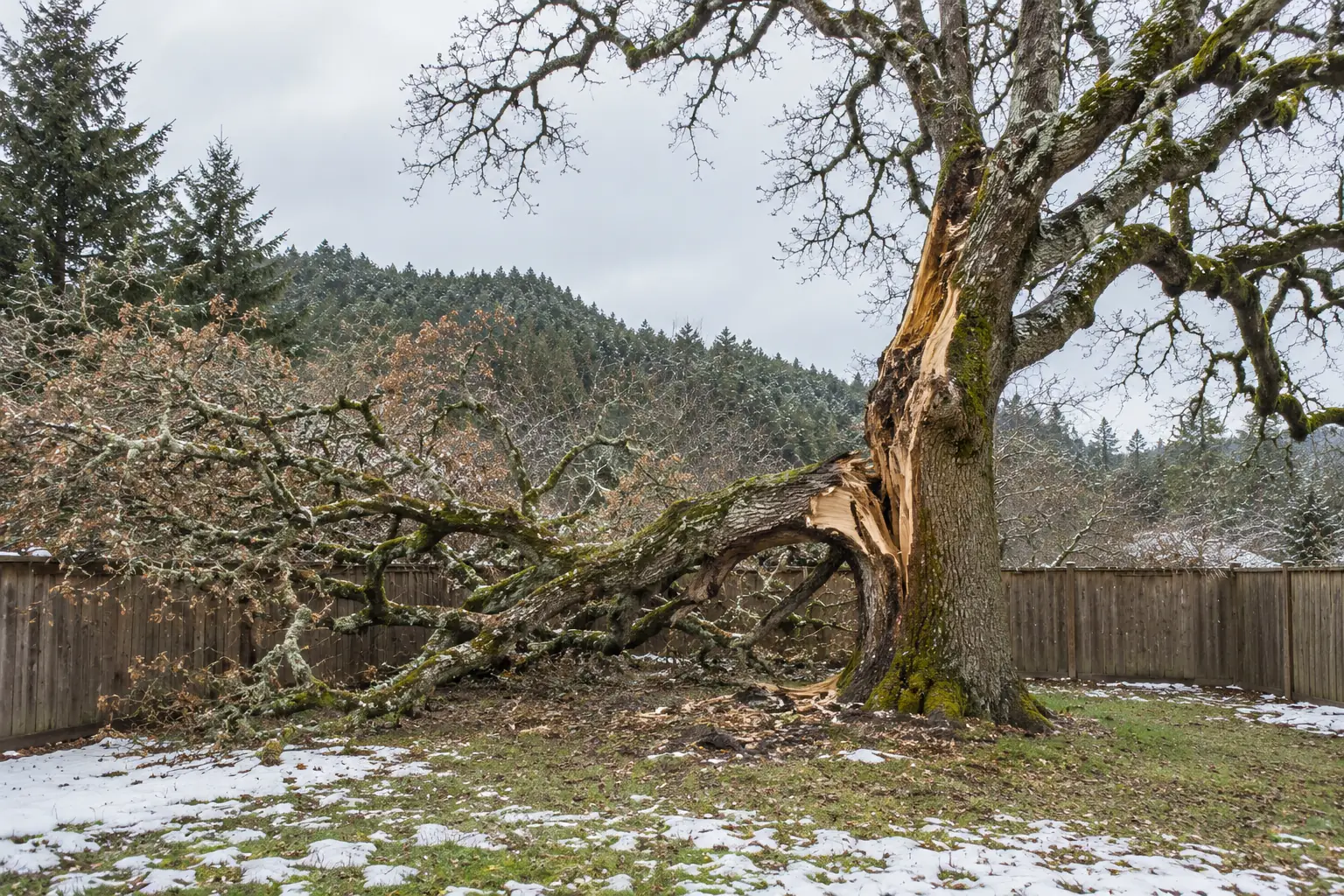
Heavy, wet snow is the winter storm that most often brings trees down in southern Oregon. The National Weather Service office in Medford's February 2019 climate summary describes a late-month storm that dropped 8 to 12 inches of heavy, wet snow on valley floors in the Umpqua Basin, causing thousands of downed trees and power outages that lasted days or weeks. The same summary notes a snow closure of I-5 between Hugo and Canyonville earlier that month and lists Josephine County among the counties in the governor's emergency declaration.
Snow is not rare in Pacific Power's southern Oregon service area either. A Pacific Power release from February 4, 2025 reported close to 11,000 Oregon customers affected by outages tied to snow and winter weather in southern Oregon.
If a storm leaves a tree on your house, your car or your driveway:
- Stay out from under hanging limbs and away from any wire.
- If a line is involved, keep 35 feet back and call 911, then Pacific Power at 1-877-508-5088. The tree company comes after both.
- Take photos from a safe distance for your insurer.
- Call (541) 507-9679 to reach a tree company. Storm weeks are busy, and no one can promise an arrival time.
The storm damage tree removal page and the emergency tree removal page explain what to do in the first hours.
Power lines and Pacific Power
Never cut, climb or prune a tree that touches or hangs near a power line. Pacific Power's tree pruning page warns that accidentally contacting a power line can be fatal and asks customers to call the utility so an arborist can evaluate the situation and identify which lines are on the property. Pacific Power's own crews and contractors prune trees near its lines at no cost as they work through an area.
The page also describes a free temporary service disconnect when tree work requires access near your service line, so a licensed company can work safely. Ask the tree company whether your job needs one, and call Pacific Power customer service at 1-888-221-7070 to arrange it. That number is for planned work on a standing tree, never for a wire that is down or a tree resting on one.
For a tree or limb that is touching, leaning on or lying across a line, the rules change. Pacific Power's storm safety page says to keep a distance of 35 feet or more from a downed line, call 911 first and report outages at 1-877-508-5088. Saw work waits until the utility has cleared the wire. The emergency tree removal page covers what to do while you wait.
What happens on removal day
On removal day, the company you hired takes the tree down in the way its estimate describes, cleans up what the estimate covers and leaves. The details depend on the tree and the yard, but most jobs follow a similar pattern.
- Setup. The crew marks a drop zone, sets cones or tape and moves people and pets away. Move cars out of the driveway and clear patio furniture before they arrive.
- Limbing. On a tree with room around it, a climber or a bucket truck takes the limbs first. In a tight yard, branches are lowered on ropes.
- The trunk. With space, the trunk can be felled in one piece. Near a house, it comes down in sections from the top.
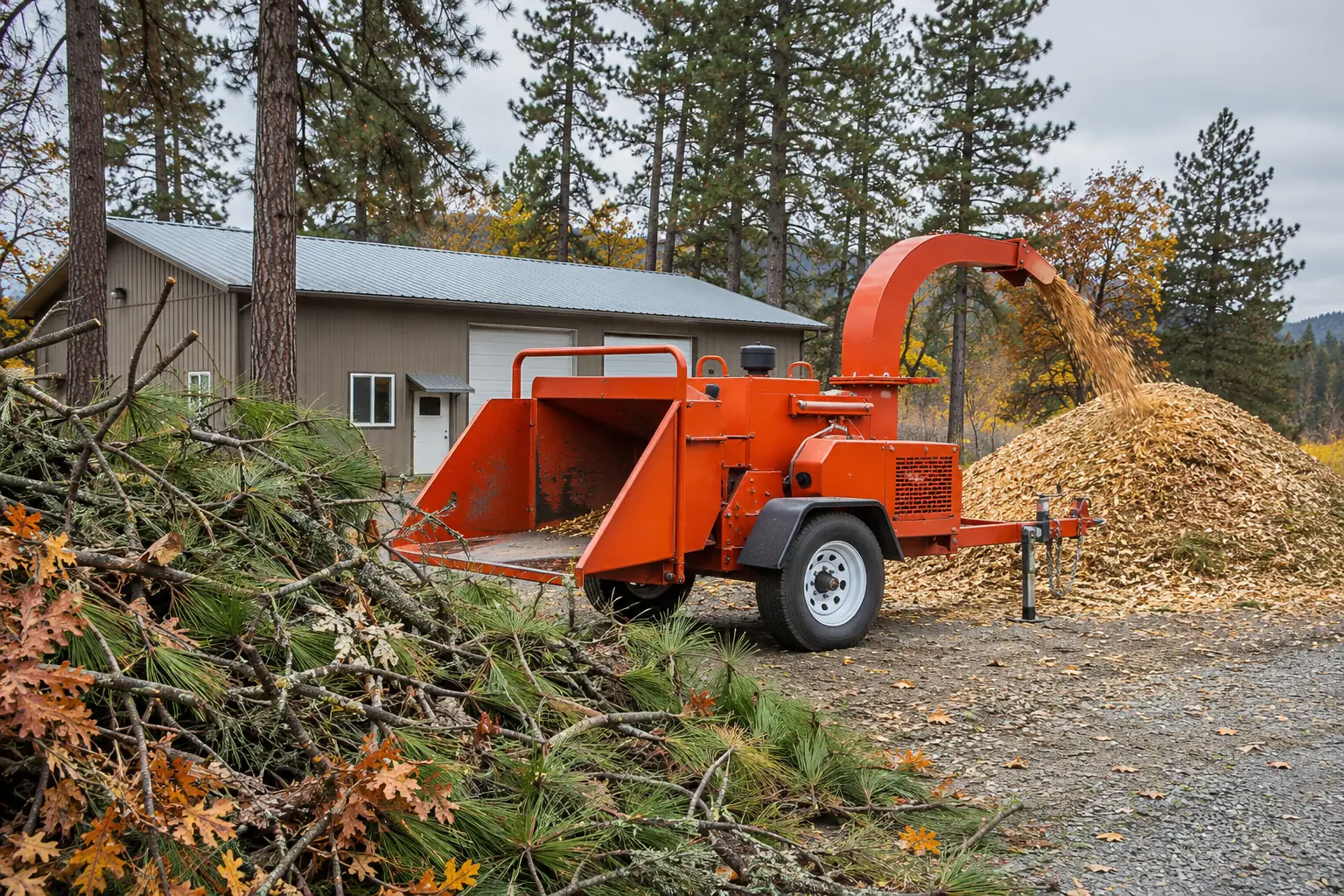
- Cleanup. Branches are usually chipped on site. Logs are hauled away, cut into rounds or left for firewood, depending on what you agreed.
- The stump. Grinding is often a separate price. The grinder chews the stump below ground level and leaves a pile of chips.
Ask the company before the day about what it will do with the wood, whether it grinds the stump, how it protects the lawn and whether anyone needs to be home. Get the answers in the written estimate. The large tree removal page and the stump grinding page cover those two jobs.
How to check a tree company before you hire
Before you agree to any work, confirm the company's license, insurance and written estimate yourself. Before the first referral, this site runs the company through the Oregon CCB's public online lookup to see its license, and that single search is the only check it makes. Your own check takes a few minutes and protects you directly.
- License. Oregon requires a license for tree removal. The Oregon Landscape Contractors Board's tree work FAQ says either an LCB license or a CCB license allows a company to remove trees, grind stumps and guy limbs. Ask for the CCB number and look it up on the Oregon CCB license search. Check that the license is active and the business name matches.
- Insurance. Ask for a certificate of liability insurance. Tree work can damage roofs, fences and neighbors' property, and you want the company's policy to cover it.
- Written estimate. The estimate should list the trees, what happens to the stump and wood, the cleanup and the total price.
- Arborist credentials. For a city right-of-way tree, the company has to be on the City of Grants Pass prequalified list and hold ISA certification. Ask for the certification number.
- Permits. Ask who pulls any permit the city or county requires. In the right-of-way, the prequalified arborist completes the city permit application.
- Payment. Be cautious of anyone who asks for full payment before the work is done.
If something goes wrong after the work, the CCB handles complaints against licensed contractors. The complaints page explains where to go.
Tree services you can ask for
You can ask the company you reach about everyday tree care as well as removals, from trimming a fruit tree or clearing brush to taking down a dead pine. Each page below explains the job, what affects the price and what to ask.
Towns near Grants Pass you can call from
Calls from homeowners in the towns around Grants Pass are routed just like calls from inside the city, to one independent licensed company. Mention your address early, because the company decides how far out it works. Referrals cover communities north toward Merlin and Hugo, south along Highway 238 toward Murphy, Provolt and Williams, and southwest along US 199 toward Wilderville, Wonder and Selma. The service areas page groups them by direction.
Guides for Grants Pass homeowners
The guides answer the questions that come up before most removals in Grants Pass: what it costs, which city rules apply, how the Hazardous Tree Program works, what fire season changes and why so many local oaks, pines and firs are struggling. Every guide links to its official sources.
Frequently asked questions
Does this site do the tree work itself?
No. Tree Removal Grants Pass is a referral service. It connects you with a Grants Pass-area tree service holding an active Oregon CCB license. Inspecting the tree, pricing the job and doing any work you hire it for are all that company's side.
How much does it cost to call?
Nothing. The call and the estimate request are free to you. Referral fees from the tree service fund this site. Whether the estimate visit itself is free is up to the company. On a routine job a fee is rare, so check while you have it on the phone. Money for tree work goes to the company alone, on terms you agree with it.
What does a tree removal run in Grants Pass?
National 2026 cost guides put most single-tree removals between a few hundred dollars and about $1,200, with very tall trees costing more. The written estimate from the company that sees your tree is the price that counts. See the cost guide for details.
Do I need a permit to remove a tree in Grants Pass?
You need a city permit to prune or remove a tree in the public right-of-way, which is usually the strip between the curb and the sidewalk. The work must be done by a city-prequalified, ISA-certified arborist. For a tree elsewhere on your lot, near a stream or on a development site, check with the city first.
Will the company I reach qualify for the Hazardous Tree Program?
Not automatically. The program requires bids from arborists the city has approved, and right-of-way work must be done by a city-prequalified, ISA-certified arborist. Ask the company whether it is on the city's current list before you rely on it for a reimbursement bid.
Can I get a tree removed during fire season?
Often, yes, but on ODF-protected land the saw rules tighten as fire danger rises, and saws are not allowed at extreme fire danger. Ask the company how it plans around the current fire danger level.
What do I do if a tree falls on a power line?
Move 35 feet or more away and assume the line carries power. Phone 911 first, followed by Pacific Power at 1-877-508-5088. Any tree company has to hold off until the utility gives the all clear.
Does the price include the stump?
Not always. Many estimates price stump grinding separately. Ask the company to list the stump, the wood and the cleanup in writing.
Which towns do referrals cover?
Grants Pass plus Merlin, Hugo, Murphy, Provolt, Williams, Wilderville, Wonder and Selma. If you live elsewhere in Josephine County, call and ask.